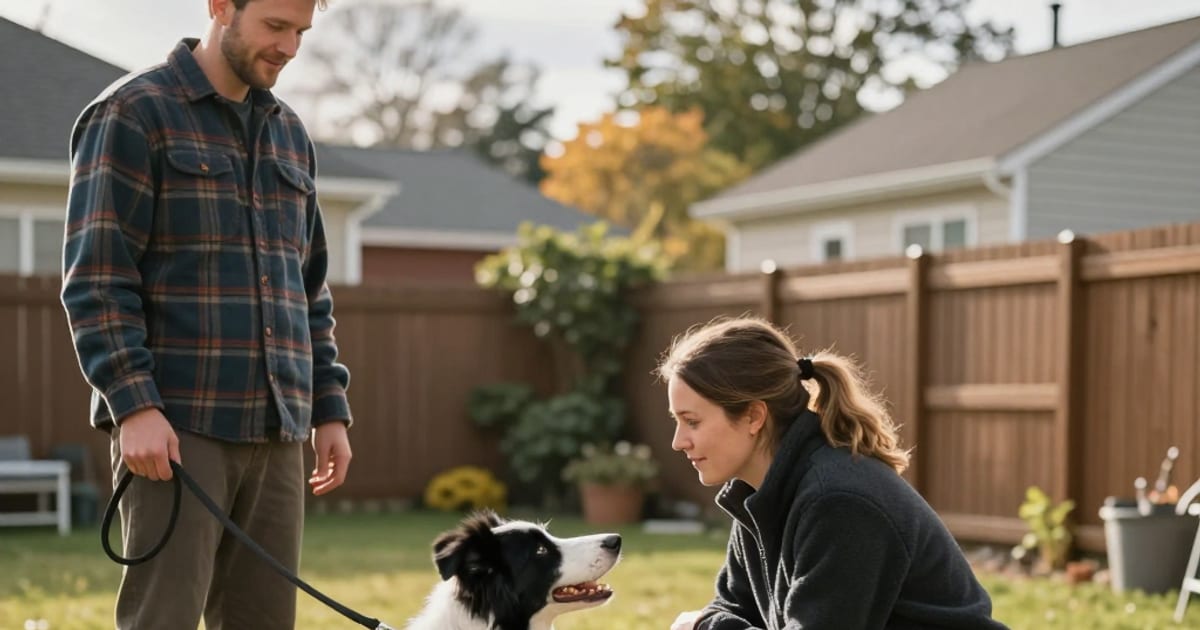
"Can we just meet at the dog park? It's two minutes from my house." You say yes, because it is a first session and the client sounds keen. On Saturday morning you arrive to find fourteen dogs off leash, a ball launcher, a fence the client's reactive terrier can see straight through, and no parking closer than a ten-minute walk. You spend the hour behind a van in the car park, working on name response with the dog's back to the gate.
The session was not a disaster. It just was not the session you planned, and the reason had nothing to do with the dog. Where you hold dog training sessions decides a lot of what the dog can learn that day, and this time the location won.
Where to hold dog training sessions, and what each location is good for
Every location sits somewhere on a scale from no distractions to constant ones. The right choice depends on the dog and the skill, not on what is closest to the client's front door.
- The client's home. Best for problems that happen at home: door manners, jumping on guests, settling, resource guarding. You see the real environment, including the doorbell, the kids and the cat, which can be useful or chaotic.
- Your own facility or training field. Controlled, familiar and set up for the work. Ideal for foundation skills and for dogs who need distance from triggers. The trade-off is that what the dog learns there does not automatically travel.
- A quiet park or open space. A good middle step for leash skills and long-line recall, as long as you pick the right corner and the right hour.
- Dog-friendly stores. Smooth floors, odd smells, trolleys and shoppers. Excellent for proofing calm behavior, once the dog is ready for it.
- Real-world places. Cafe terraces, town centres, trail heads, the vet's car park. This is where the training has to hold in the end, so it belongs late in a program, not at the start.
How to scout a training location before you book a client there
Visit before you use it, and visit at the time of day you will actually train. A park that is empty at lunchtime on a weekday can be packed on a weekend morning. Walk it with a short checklist and write down what you find:
- Distractions. Other dogs, off-leash areas, wildlife, playgrounds, bikes, traffic noise. Note where they come from and how much distance you can get.
- Surfaces. Grass, gravel, wet decking, hot pavement in summer. Some dogs will not lie down on cold, wet ground.
- Space and exits. Room to back away from a trigger, and a way out that does not walk you straight past it.
- Parking and the walk in. A reactive dog's session can be over before it starts if the only path from the car runs along a busy dog-walking route.
- Shade, water and a toilet for you, the client and the dog.
- Rules and permission. Leash laws, opening hours, rules on commercial use, and whether whoever owns the space is happy for you to be there.
After a few visits you will have your own ratings for each place, and they are worth more than any review site, because they are judged on what matters to a training session.
Ask permission, and check what your insurance covers
Using a public park for paid sessions is often fine and sometimes not. Some councils and park authorities ask for a permit for commercial activity, and some limit how many dogs a professional can bring. The rules vary a lot by area, so check with the local authority rather than assuming.
Private spaces need a clear yes. Stores that welcome you will usually tell you which hours are quietest. A farmer's field or a friend's paddock can be a superb secure space, but get the arrangement in writing and agree what happens if something gets damaged. Then confirm with your insurer that your policy covers sessions away from your own premises, and make sure your waiver mentions training in public places. The guide to dog training consent forms and waivers covers what to include.
Moving a dog through harder locations
A dog who sits beautifully in the living room has learned to sit in the living room. Getting that sit to hold in a busy town centre is separate work, and location is one of the easiest variables you control. Plan the route through places the same way you plan the skills.
A typical progression runs from home or your facility, to a quiet park at a quiet hour, to the same park at a busier time, to a dog-friendly store, and finally to the places the owner actually goes. Move up when the dog gets it right most of the time at the current level, and step back without fuss when it falls apart. Record where each session took place. Your session notes then show not only that loose-leash walking improved, but where it improved, which tells you when to move on.
A location is a training variable, not a convenience. Choose it the way you choose the distance from a trigger.
Keep training addresses private
Training locations come with an awkward privacy problem. Your best quiet field might be behind your own house. The secure paddock belongs to someone who agreed to a few sessions a week, not to a public listing. And in-home sessions mean you hold a list of client addresses that should never end up in a group message or a shared spreadsheet.
The rule is simple: an exact address goes only to the people booked there. Describe general areas on your website ("north side, near the river"), and send the precise spot with the booking. Do not paste a client's address into a team chat when a colleague is covering, and never put a private location in a message that goes to several clients at once.
Help clients pick the place nearest to them
Once you have a short list of vetted locations, the remaining job is getting each client to the right one without a string of messages. Clients choose well when they can see the options on a map next to their own home, with your notes on what each place is like, and they arrive on time when directions are one tap away.
In HeelYeah, you set up approved training locations and clients book at the places you have vetted, each rated on stats you define, such as distractions or parking. Clients see a Home marker on the location map, so they can pick the closest place, and if you allow it they can choose somewhere else instead, with their own address offered as a one-tap fill for in-home work. Locations you mark private are shown only to the client booked there. While a booking is live, the client gets a one-tap Navigate button for Apple Maps or Google Maps, and board and train programs, boarding stays and daycare visits get a location too. It all runs on one calendar, with per-trainer availability and conflict checking on every booking.
From a trainer using HeelYeah
“HeelYeah has made it so much easier to keep every part of my dog training business organized in one place. From client and pet information to paperwork, scheduling, and payments, everything is easy to find and manage.”
The best training location is the one that sets the dog up to succeed today and moves him a step closer to the real world tomorrow. Scout it, rate it, get permission, keep the address to the people who need it, and the next time a client suggests the dog park on a Saturday, you will have a better answer ready.