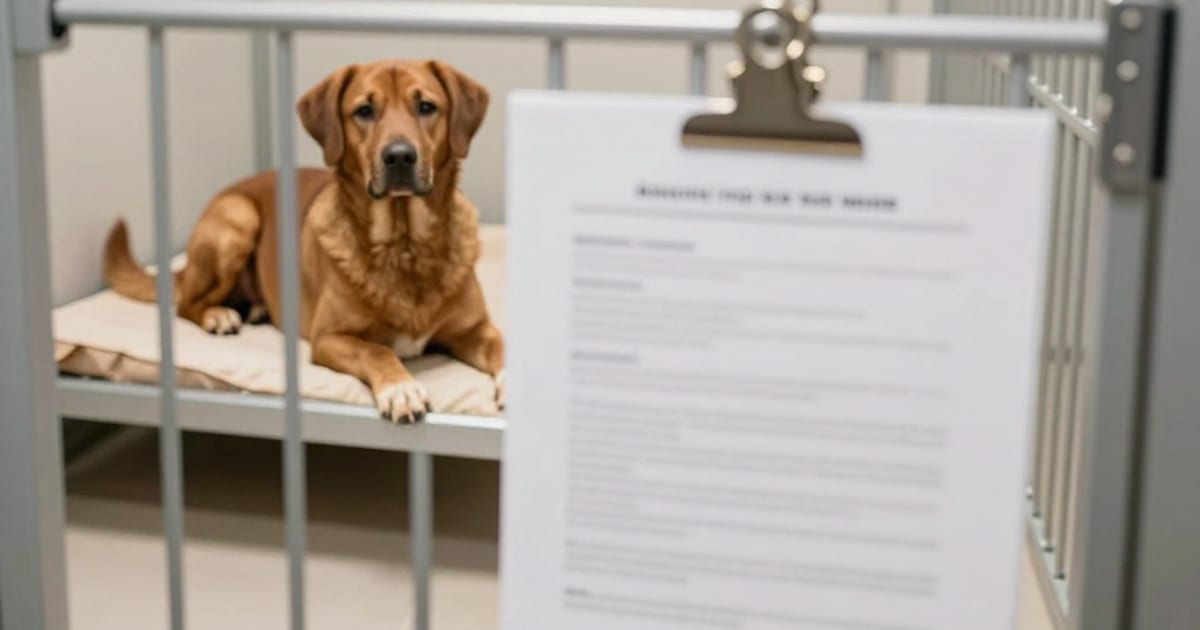
Two cups. That is what the kennel card on run 9 said, in neat marker, under "Breakfast" and again under "Dinner". It had said two cups since the afternoon Bailey checked in.
On day three his owner emailed. The vet wanted him down to one and a half cups, because of his weight, and could you please make sure. The manager read the email, updated the booking and replied that it was all in hand. Nobody touched the card. The weekend team, who never open the email inbox and work entirely from the kennel cards taped to the run doors, fed Bailey two cups a meal for four more days.
Nobody did anything wrong, exactly. The office had the right answer. The card had the old one. And the card is the one with a dog bowl in front of it.
What is a kennel card actually for?
A kennel card is the last step between your records and the dog. Whoever is standing at the run with a leash in one hand and a bowl in the other is not going to walk to the office to check a screen. They will read the card.
That gives you a simple test for any card design: could a relief staffer who has never met this dog care for it safely, for a whole day, using only what is on the card? If the answer depends on asking someone, the card is decoration.
It also means the card is a safety document first and a nice touch second. A photo and the dog's name in a fun font are good. A medication dose in small print at the bottom is not.
What every kennel card must show
Whether you print them from software or fill in a template, this is the checklist. Copy it, then cross off anything your current card is missing.
- Name and a photo. A description at minimum ("black lab, female, red collar"), because two black labs in neighboring runs is a Tuesday.
- Run, arrival date and checkout date. So staff know the dog is in the right place and how long the plan runs.
- Medications, first. Drug, dose, times and whether it goes with food, on its own line, in type nobody has to squint at.
- Feeding. Which food, how much in your measure, and when.
- Allergies and dietary restrictions. Including the treats you are not allowed to give.
- Behavior and handling warnings. Guards food, slips collars, no dogs on the left, lead on before the door opens.
- Belongings. The bed, the blanket, the toy that must go home.
- Emergency contact and vet. Name and phone number for both.
- A daily care grid. A box per feed, dose and turnout, per day, for staff to initial.
Put the dangerous things where the eye lands first
Order matters more than layout. People read a card top to bottom and stop when they think they have what they need. So the top of the card should be the things that hurt a dog when they are missed: identity, handling warnings, medications, then feeding. Belongings and notes can wait for the bottom.
Resist the urge to fit everything on one page. A card that shrinks the medication line to eight point type to keep the layout tidy has its priorities backwards. If a dog needs two pages, print two pages, and put the dog's name, photo and run at the top of each, because pages get separated on a kennel floor.
Make empty sections say so. If the medication section is blank, a staff member cannot tell "this dog takes nothing" from "the medication did not print". Write "None" under it. A missing emergency contact should say "Not recorded", in capitals, so someone notices and fixes it instead of assuming it is fine.
A kennel card is a copy of the truth, and every copy starts going out of date the moment it is printed.
Why handwritten kennel cards go stale
The trouble with any kennel card, handwritten or printed, is that it is a copy. The real plan lives somewhere else: in the booking, the intake form, the manager's head. Copies drift.
Count how often a boarding dog's plan changes mid-stay. The owner calls to say a medication finished early. The vet adjusts a dose. The dog has loose stool and the manager adds a bland diet for two days. A staff member notices the dog cannot be walked with others. The dog moves runs because of a leak. Each change has to be made twice, once in the record and once on the card, and the second one is always the one that gets missed, because it is a walk across the building at a busy moment.
Handwritten cards make it worse in a particular way. Corrections pile up in different pens, crossings-out look like instructions, and a card with three edits is harder to read than one with none. A dog's card should never be a history of the stay. It should be the current plan, and nothing else.
Reprint the card whenever the schedule changes
The fix is a rule, not a better pen: any change to medication, feeding, the care schedule or the run means a new card, and the old one goes in the trash. Not amended in pen. Replaced.
- Print the date and time on every card. Then anyone can see whether the card predates the change they heard about.
- Make one person responsible. Whoever changes the plan prints the card, before they move on to anything else.
- Check cards at shift change. A quick walk of the aisle comparing print times against the day's changes catches the ones that slipped.
This is much easier when the card is printed from the same record staff update, rather than retyped. Then a reprint is one click, and the new card cannot disagree with the screen. The same information feeds the rest of the stay, which is why it pays to collect it properly at booking, as in a good intake form.
Kennel cards for daycare dogs are a different card
A day guest does not need a nine-day care grid or a checkout date next week. Printing a boarding card for a daycare dog buries the two things staff need that day: when the dog is being picked up, and which play group it is in.
A daycare card should be short: name and photo, belongings, today's medications, the length of the day, the expected pickup time and the play group. One sheet, gone at close.
HeelYeah prints both. The boarding kennel card puts feeding, medications, belongings, the care schedule and notes on one sheet for the run door, and it is offered for printing the moment a dog is checked in. Every print re-renders from live data, and once a dog's schedule changes, the card is flagged for reprint so nobody works off yesterday's paper. Medications lead the card, the dog's photo, emergency contact, vet and behavior tags repeat at the top of every page, an empty medication list says "None recorded" and a missing contact prints "Not recorded". For day guests there is a single-day daycare card with belongings, today's medications, the day length, the expected pickup time and the play group. Both come from the same records as the rest of kennel management, which is the idea behind running a kennel without a whiteboard.
From a trainer using HeelYeah
“HeelYeah has made it so much easier to keep every part of my dog training business organized in one place. From client and pet information to paperwork, scheduling, and payments, everything is easy to find and manage.”
Pull the card off one run door today and hold it up against the dog's record. If the two disagree about anything, you have found the next Bailey before he finds you.