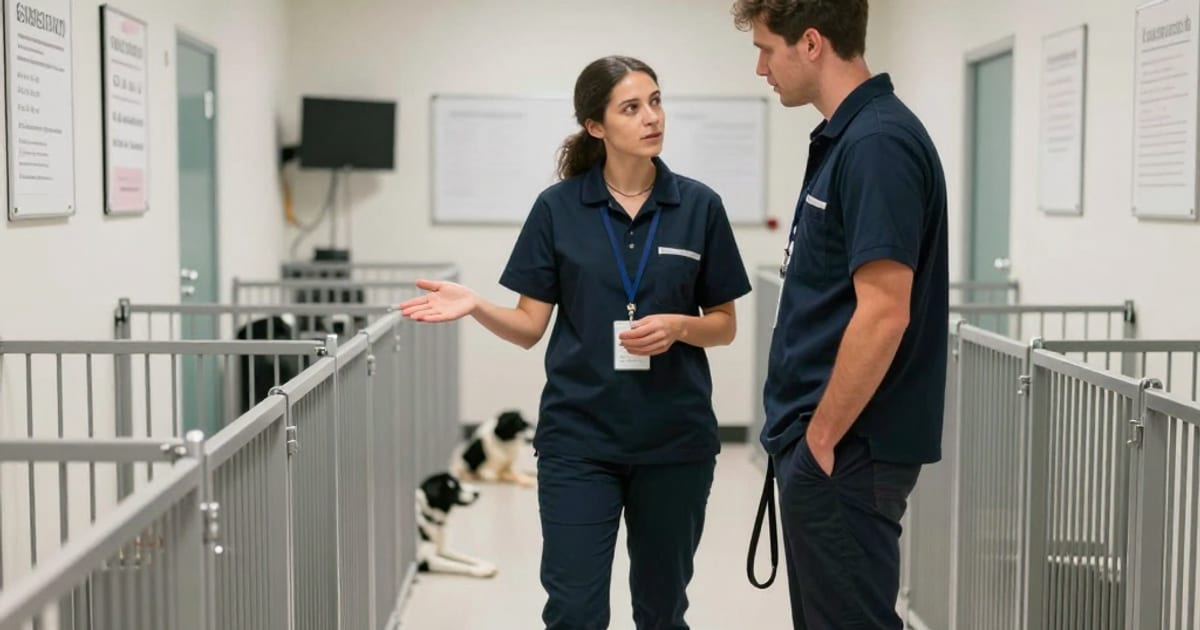
"Rocco was a bit off this morning."
That was the whole message, and the whole kennel staff shift handoff, posted to the group chat just before the morning shift went home. The afternoon kennel staff read it an hour later, between a check-in and a run that needed hosing, and it sat there under a photo of somebody's lunch and a question about who had moved the hose. Off how? Did he eat? Had anyone told the owner? The person who wrote it had already left, and her phone was on silent.
By five o'clock Rocco had vomited twice and left his dinner. Looking back, the morning note was right. It just was not something anyone on the next shift could do anything with.
Why the shift change is where boarding facilities lose information
A boarding facility runs on a lot of small facts that live in people's heads: which dog was slow to eat, which run had a dripping tap, which owner asked for a call back, which dog is fine with the dog next door but not the one opposite. During a shift, that knowledge works well. The person who noticed is the person who acts.
At shift change, all of it has to move from one head to another in a few minutes, usually while the phone is ringing and a dog is arriving. The outgoing person is tired and wants to leave. The incoming person is still taking their coat off. Whatever is not written down somewhere useful leaves with the outgoing shift.
That is why the kennel staff shift handoff deserves its own routine. Not a longer meeting. A better one.
Why the group chat and the clipboard both fail
The group chat is where most dog boarding staff communication ends up, because everyone already has it on their phone. Its problems are built in. Messages are not attached to a dog, so "Rocco" means nothing to the relief staffer who does not know which one he is. Important notes scroll away under jokes and shift swaps. Staff who are not in the chat, or who have muted it, never see them. And the record lives on personal phones, not with the business.
The clipboard on the run door has the opposite problem. It is attached to the dog, but you only see it when you are standing in front of that run. Nobody walking the aisle can tell which of thirty clipboards has something new on it, and the manager cannot read any of them from home.
What works is a record that is attached to the dog, readable from anywhere, and impossible to scroll past.
What a good kennel staff shift handoff covers
A good handoff is not a recap of everything that happened. It is the list of things the next person needs to know to avoid a mistake or finish a job.
- Any dog with a concern: what was seen, when, what was done about it, and what to watch for next.
- Care that did not happen, and why: the dose refused, the turnout skipped because of rain, the meal left.
- Unusual care coming up: the insulin at 6, the late dinner, the dog who needs walking alone.
- Arrivals and departures still to come: with any outstanding balance, missing vaccine record or belongings to hand back.
- Runs that are not ready: still in cleaning, or out of service with the reason.
- Promises made to owners: "I said we'd send a photo tonight."
- Anything waiting on a manager's decision.
How to write a care note the next person can act on
Most bad handoff notes are not lazy. They are written by someone who knows the context and forgets the reader does not. "A bit off" made perfect sense to the person who watched Rocco all morning.
A useful care note answers four questions: what you saw, when, what you did, and what the next person should do. Compare the original note with this one: "Rocco: left half his breakfast at 7:15, drinking normally, soft stool at the 9:30 turnout. Offered the rest at 10, didn't take it. Please offer lunch at 12 and log how much he eats. If he vomits or skips dinner, call the manager." It takes forty seconds longer to write and saves the afternoon shift from guessing. It is the same discipline that makes good session notes worth reading.
Then mark it as a concern, so it is not one routine note among forty. "Ate well, good energy" and "vomited twice" should never look the same on a care sheet. The next shift should be able to see at a glance which dogs need a closer eye, before they start reading.
A care note is not written for the person who saw it happen. It is written for the person who walks in after lunch and has never met the dog.
Running the floor when the manager is not in the building
Plenty of facility owners are not on the floor all day. They are at a second site, out on a training session, or on the other side of the country at a seminar. They still need to answer questions like "has the 6pm insulin been given?" without calling someone who is mid-turnout.
Two things make that possible. The first is that care is ticked when it happens, in a shared record, so a manager can see what is done and what is overdue from wherever they are. The second is less obvious: time zones. An owner reading the day's schedule from a hotel two hours behind needs to see 6pm as the building's 6pm, not her phone's. A dose that looks "due in two hours" when it was due an hour ago is how remote managers get false comfort.
It is also worth giving staff access that fits their job. A kennel assistant needs to log care, read notes and see the floor. They do not need billing or client payment details. Clear roles make it easier to bring on new staff without worrying about what they can see, something covered in more detail in hiring trainers for your business.
A 5-minute kennel shift handoff routine
Run it at the same point in every shift change, standing up, ideally where both people can see the same screen:
- Outgoing clears their ticks. Every feed, dose and turnout due on their shift is either ticked or has a note saying why not.
- Walk the open list together. Missed care, dogs with no run, runs in cleaning or out of service, vaccines expiring before checkout, double bookings.
- Read the concern notes aloud. Thirty seconds per dog: what, when, what next.
- Check what is left at the front desk. Arrivals and departures still due, and anything owed or owed back.
- Incoming says back the first two things they will check. If they cannot name them, the handoff is not finished.
HeelYeah's kennel management is built around that list. Staff tick feeds, doses and turnouts on the Care Floor as they happen, and care notes can be marked as a concern, with quick picks like "Didn't eat", "Vomited" and "Limping", so the care sheet flags them for the next shift. The Needs-attention rail collects vaccines expiring before checkout, dogs with no run assigned, runs awaiting turnover, runs out of service, double-booked runs and care that came due and was not done. Each run is set to available, cleaning or out of service from the floor plan, every kennel screen shows the facility's own local time, and custom roles built from granular permissions sit on top of the built-in owner, admin, trainer and billing roles.
From a trainer using HeelYeah
“HeelYeah has made it so much easier to keep every part of my dog training business organized in one place. From client and pet information to paperwork, scheduling, and payments, everything is easy to find and manage.”
The group chat can stay for shift swaps and lunch photos. Rocco's breakfast belongs somewhere the next person will actually see it, with enough detail that they know what to do next.