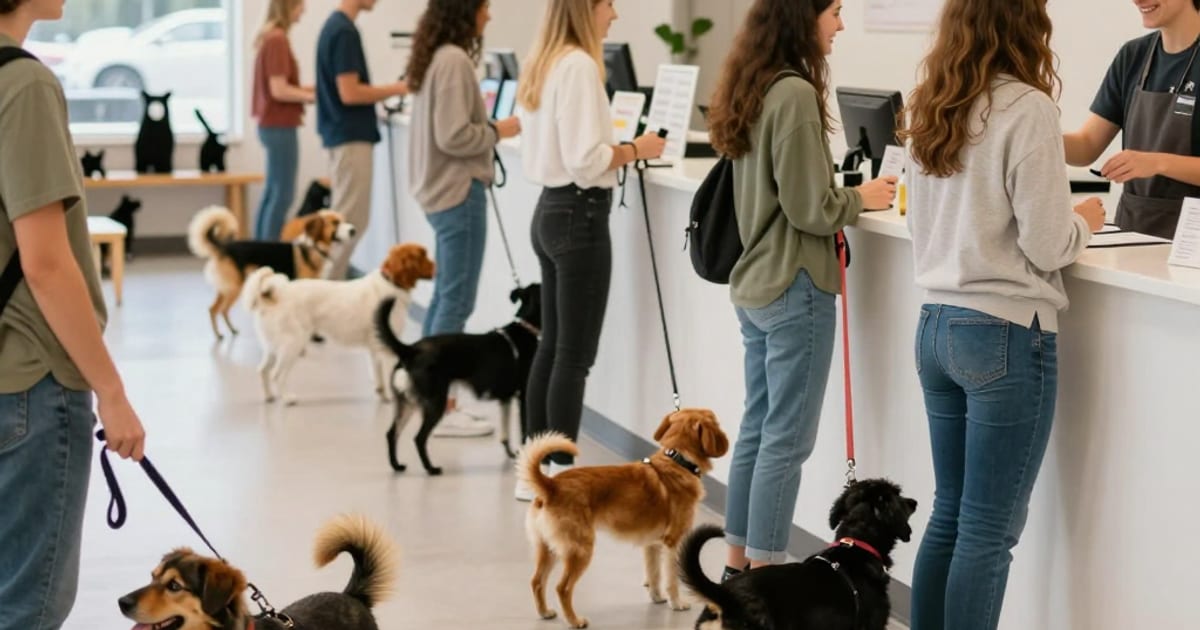
Eleven leashes on the hooks by the door, and four more owners in the lobby. One is holding a sandwich bag of pills with no name on it. One says the kennel cough booster was done last week and she will email the paperwork later. A dad on his way to the train mentions, as he hands over the leash, that his mother-in-law is collecting today.
The person behind the desk hears all of it while the phone rings and a beagle tries to climb the counter. By the time the lobby clears and the last dog daycare check-in is done, a dog with expired bordetella is in the big yard, the bag of pills is sitting next to the card reader, and the mother-in-law's name is on a sticky note that will be gone by lunch.
Nobody did anything careless. The check-in process just was not built for fifteen dogs in twenty minutes. Here is one that is.
Why daycare check-in is harder than boarding check-in
A boarding check-in happens once per stay, at a time you usually agreed in advance. You can give it ten minutes. A daycare check-in happens every morning, for most of your dogs, inside the same forty-five minute window before everyone's commute.
The other difference is familiarity. When the same dogs arrive four days a week, it gets very easy to skip a step because "it's just Biscuit". That is exactly when a vaccine lapses or a new medication appears. We covered the boarding side in dog boarding and kennel management. Daycare needs the same checks, done faster, every single day.
The five things to confirm at every dog daycare check-in
- Vaccines are current today. Not on the day the visit was booked. Today.
- The dog is still eligible. Passed the evaluation, booked for today or covered by a membership, assigned to a play group, and not on any hold since last time.
- Belongings. What came in: leash, collar, harness, lunch, a toy. Write it down, because it all has to go home again.
- Food and medication for today. What, when, how much, in a labeled container. No unlabeled bags, ever.
- Who is picking up, and when. Full day or half day, the expected pickup time, and whether anyone other than the owner is coming.
Every one of those is a ten-second question if you already know the answer, and a five-minute problem if you find out in the lobby.
Do the checking before the lobby fills up
The fastest check-in is one where the thinking was done the day before. Every afternoon, someone runs tomorrow's list: who is booked, whose vaccines expire this week, which dogs have medication, which ones are new or coming back after a long break.
A dog with a vaccine expiring tomorrow gets an email today, while the owner still has time to send the record. A dog with new meds gets a note to bring them in a labeled container. By the morning, most dogs need nothing but a hello. Your front desk is then free to deal with the one dog who actually needs attention.
A fast check-in does not skip the checks. It does them before the owner walks in.
Should a missing vaccine block check-in or just warn you?
This is a policy decision, and you should make it once rather than at the desk every morning. A hard block is simple and fair: no current record, no group play, and the owner goes home with the dog. It is also a difficult conversation at twenty to eight with someone who is late for work.
A warning gives staff room for judgement: the record is on its way, the vet's office opens at nine, the dog can wait in a run until it arrives. That flexibility only works if your staff apply it the same way every time. Whichever you choose, put it in your policy, tell clients when they sign up, and remind them a few days before a record expires. Requirements vary by region, so check what your local regulations and insurer expect.
How to check in a whole lobby without losing the individual check
At peak, split the job in two. One person stays at the desk and checks dogs in. A second person runs dogs back to their play groups. The desk never leaves the desk, and dogs never wait on leashes tangled together by the door.
Check the lobby in as a batch, but judge each dog on its own. If one dog has a problem (an expired record, a membership that is used up, no booking for today), that dog steps aside and the rest go through. One dog's paperwork should never hold up nine others.
As dogs go back, keep a live count per play group. Your small-dog yard might cap at a number you chose for good reasons. Know when it is full before the fourth chihuahua is walked through the gate, not after.
What happens after the leash is handed over
Send the owner a drop-off confirmation, so the other parent at home knows the dog arrived. Put a card on the run door with the dog's belongings, today's medications, the expected pickup time and the play group, so whoever is on the floor at two o'clock does not have to ask the desk. At check-out, walk the belongings list as you hand things back, and write down who actually collected the dog. A clear client communication habit at drop-off and pickup heads off most of the calls you would otherwise get at noon.
How HeelYeah runs the morning rush
In HeelYeah, the front desk selects every dog in the lobby and checks them all in with one submit. Each dog is still gated and charged on its own, so one dog's issue never blocks the rest. The vaccine gate blocks or warns, depending on how you set it. Play groups have a size cap with a manager override for one-off days, and the board shows a live headcount per group. Membership allowances are enforced at check-in too.
Checking dogs in or out emails the client one confirmation for the whole household, naming every dog and the time; texts are optional per event. Each day guest gets a single-day kennel card with belongings, today's medications, the expected pickup time and the play group, and their meals and meds show up on the same Care Floor as your boarding dogs. Clients can book their own days from the portal, routed to an approval queue or straight to arrivals. At check-out you walk the belongings checklist and record who collected the dog. See it all on the kennel management page.
From a trainer using HeelYeah
“HeelYeah has made it so much easier to keep every part of my dog training business organized in one place. From client and pet information to paperwork, scheduling, and payments, everything is easy to find and manage.”
Pick the five checks, move as many as you can to the afternoon before, and split the desk from the runner. The lobby will still be busy. It just will not be where mistakes happen.