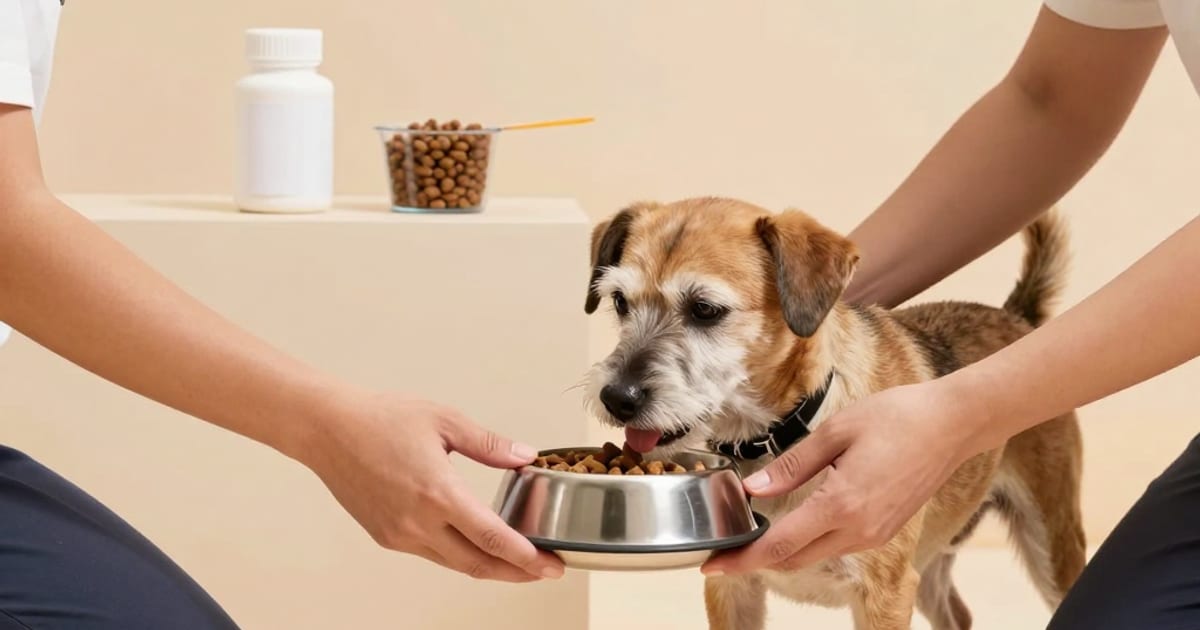
The bag arrives looped over the leash, which is how a lot of dog boarding medication arrives. A freezer bag, folded twice, with three kinds of pills rolling around the bottom, a tin of wet food, a scoop with no size marked on it, and a note in marker on the outside: "1 in morn, half at night w food. Joints + tummy."
The owner is already halfway back to the car. "It's all in there," she calls. "She's really easy."
She probably is. But right now you have a dog on three medications, one of which is being halved, one of which is apparently for her stomach, and no way to tell which is which. Everything that happens with this dog's care for the next nine nights depends on the next two minutes, and the owner is backing out of the parking lot.
What to collect for every dog boarding medication
Medication errors in boarding are rarely about carelessness. They come from instructions that were never complete in the first place. Ask for the same things, in the same order, for every medication, every time:
- The name and strength, as printed on the label. "Carprofen 75 mg", not "the joint one". Medication should arrive in its original labelled container.
- The dose in the units your staff will use. One tablet, half a tablet, 0.5 ml. If a tablet is halved, ask the owner to pre-split it or bring a pill cutter.
- The times. "Twice a day" is not a time. Agree on actual ones, fitted to your routine.
- With food or on an empty stomach. Some medicines must go in with a meal; insulin is often given only after the dog has eaten.
- What it is for. It tells staff what to watch for, and it tells a vet what they are dealing with if something goes wrong.
- What a missed or refused dose means. Skip it and carry on, give it late, or call? Ask the owner what their vet has told them.
- How the dog takes it. Pill pocket, wrapped in cheese, crushed into wet food, or straight down the throat.
- Enough supply. Count it against the length of the stay, plus a spare day.
Most of this belongs on the booking form, so you are confirming rather than collecting at the door. The same discipline makes a good board and train intake form.
Confirm the plan at the door, out loud
Even with a complete form, read the medication and feeding plan back to the owner at check-in. "Carprofen, one tablet at 7 with breakfast. Omeprazole, one at 6 before dinner. Gabapentin, half a tablet at 9pm. One and a half cups of her own food morning and evening." It takes thirty seconds.
That read-back is where the real changes surface. "Oh, we stopped the omeprazole last week." "Actually the vet upped it to a whole tablet." Owners change routines and forget the form. The door is your last chance to hear about it.
Never let the read-back hold up a busy lobby. If the owner has to run, check the dog in, note what still needs confirming, and phone them within the hour. A plan with one open question is fine. A plan nobody ever checked is not.
Write the dose on the row, not in the file
The person giving a medication should never have to go and look anything up. If the care list says "meds AM" and the details live in the office, someone will eventually give a whole tablet where a half was prescribed, because the bottle says one tablet and the change was in the notes.
Every medication line should carry the dog, drug, dose, time and food rule. "Luna, carprofen 75 mg, 1 tablet, 7:00 AM, with breakfast." The same goes for feeding: "1.5 cups own kibble" in your measuring cup, not "one scoop" in a scoop nobody can identify. Convert the owner's measures at intake, once.
Building a feeding schedule for boarding dogs
Thirty dogs on thirty personal schedules is unworkable. Thirty dogs on one rigid schedule ignores the diabetic, the toy breed who needs three small meals, and the slow senior who eats apart.
The workable answer is a house routine plus exceptions. Set the facility's standard slots once, for example breakfast at 7:00, a midday turnout, and dinner at 5:00, and every boarding dog inherits them. Then adjust individual dogs on top: an extra noon meal for the puppy, insulin tied to breakfast and dinner, a later dinner for the dog who will not eat until the building is quiet.
Those adjustments need to survive when the house routine changes. If you move dinner from 5:00 to 4:30 for the winter, the dog with a personal 9pm meal should keep it, and the person feeding should still be able to see that it is an exception and why.
"Didn't eat" is not something the next shift should have to discover for themselves.
What to do when a boarding dog won't eat
Plenty of dogs skip a meal or two in the first day or so of a stay. New smells, new noise, a missing owner. On its own that is usually not an emergency for a healthy adult dog, but it changes the plan, especially when a medication has to go in with food.
Things worth trying, with the owner's permission recorded at intake: feed in a quieter spot, hand-feed a few pieces, add a little warm water, or add a spoonful of the owner's wet food. Do not swap foods without asking, because a sudden change often brings loose stool along with it.
Agree your escalation points in advance and write them into your policy. A reasonable example: a healthy adult that refuses food for 24 hours gets a call to the owner, and 48 hours means a call to the vet. Puppies, toy breeds, diabetics and dogs on medication that must be given with food get much shorter limits. Log every refusal, including partial ones. "Ate about half" at three meals in a row is a pattern. "Fine" is not a record.
Log it so the next shift and the owner can see it
Every feed and every dose should be ticked when it happens, by the person who did it, at the time they did it. Not at the end of the shift from memory. A tick gives you two things: the next person knows not to double-dose, and anything that came due without a tick is visible as missed while there is still time to act.
Notes need the same care. A note that a dog vomited or would not eat has to stand out from the dozens of routine notes around it, so the evening shift reads it before they reach for the dinner bowls. And at pickup, the owner deserves better than "she was fine": "She ate everything except Tuesday breakfast, and had every dose on time" is what earns the next booking.
In HeelYeah's kennel management, this is the Care Floor: the whole building's feeds, medications and turnouts for the day, grouped into morning, midday and evening, with the dose and amount on the row and each one ticked as it happens. A house care routine gives every boarding dog the standard slots, with per-dog adjustments that keep their identity when the house routine changes. At check-in, a care review confirms the feeding and medication with the owner at the door, and it never blocks the check-in. Staff log care notes with quick picks like "Didn't eat" or "Vomited" that mark the note as a concern, so the care sheet flags it for the next shift, and care that came due and was not done lands on the Needs-attention rail. You choose whether owners can see the notes from their dog's stays.
From a trainer using HeelYeah
“HeelYeah has made it so much easier to keep every part of my dog training business organized in one place. From client and pet information to paperwork, scheduling, and payments, everything is easy to find and manage.”
The freezer bag will still turn up looped over a leash. The difference is that by the time the owner reaches her car, every pill in it has a name, a dose, a time and a reason, written where the person holding the bowl will see it.